
August 23, 2009
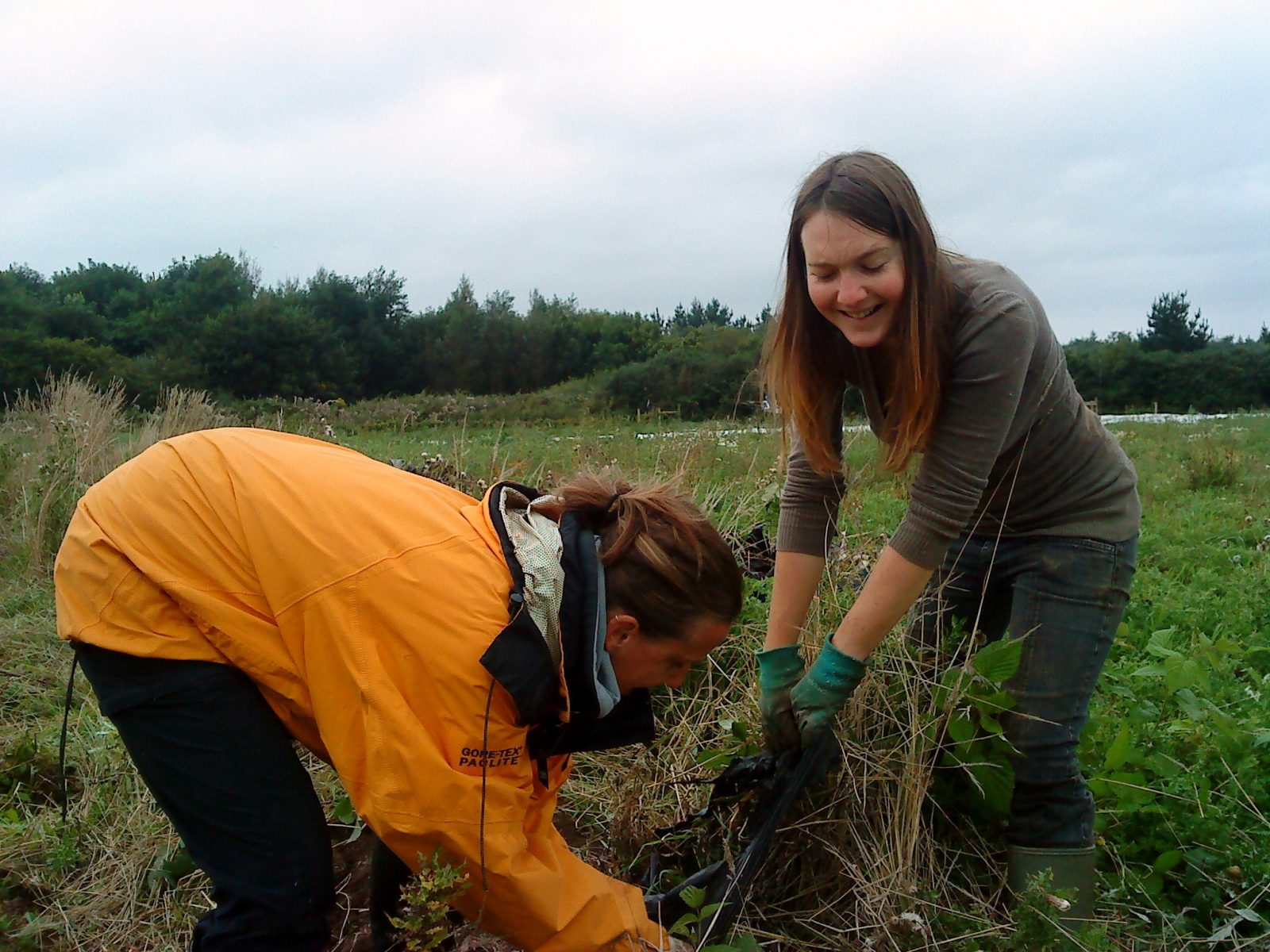
Camel CSA volunteers have almost completed the back-breaking task of removing the black plastic mulch from the overgrown strawberry beds. Now we can go ahead and sow a crop of green manure.
The hit team comprised expert grower Jane plus Danny, Mike H and Mike S. Charlotte made a start on the weeds in the beetroot bed.
We’re looking forward with mixed feelings to our next big task. We need to weed the hundreds of brassica plants that we planted last month.
Red cabbage, two varieties of green cabbage, cauliflower, red and green kale, and purple sprouting broccoli are all being shielded from predators under huge swathes of protective fleece.
Friday’s picking and packing team included Trish – who supervised the packing – Charlotte, Mike H, Penny and Robert.
Food intuition
We’ve had a visit on site from our newest member Gabriel Evans, a chef from New Zealand, who is author of the Food Intuition online food journal.
Gabe’s setting up a cookery school in St Columb, near Newquay. He says:
“There’s lot of misinformation and confusion around food and diet. My focus is on natural, wholesome food; what it really is, where to get it and how to prepare, cook and eat it.”
We assume that includes the vegetables grown on Camel Community Supported Agriculture’s plot at St Kew Highway!
August 21, 2009
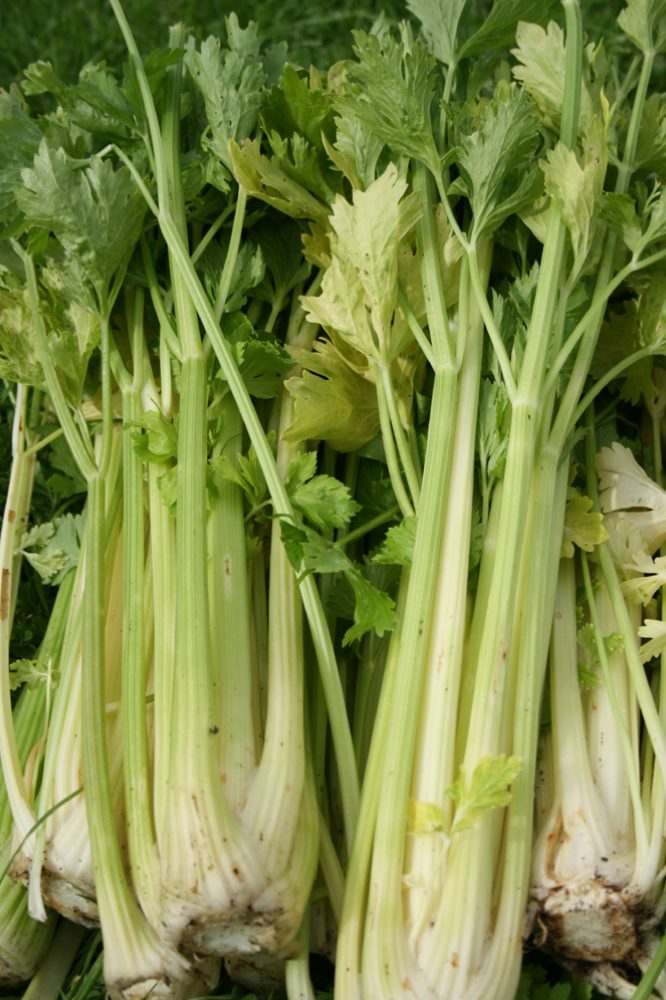
One of the staples of the kitchen, celery is used to flavour soups, stocks and many other dishes. It is tasty on its own as a vegetable dish, gives crunch to salads especially a Waldorf salad.
This recipe is from Alice Waters’ The Art of Simple Food.
Preparation time: 5 minutes
Cooking time: 15-20 minutes
Serves 4
Ingredients
1 head of celery
2 tbsp olive oil
1 small onion, peeled and thinly sliced
2 or 3 thyme sprigs
salt
225ml chicken, beef or vegetable stock
Method
Trim the root end close to the bottom of the stalks and cut off the leafy tops. Pull of the outer stalks to expose the pale green heart. Cut the group of stalks at the heart in half lengthwise and then in half again as wedges. Line up all the stalks and cut in half crosswise.
Into a heavy pan over medium heat, pour in the oil and add the onion and thyme. Cook for 5 minutes. Add the celery. Cook for 5 to 7 minutes, until the onions and celery have browned a little. Season with salt and add the stock. Bring to the boil. Lower the heat to a simmer. Cover the pan and cook until the celery is tender. The sauce should be thick and coat the celery; if not, uncover the pan, raise the heat and reduce the liquid as much as needed. Taste for seasoning and serve.
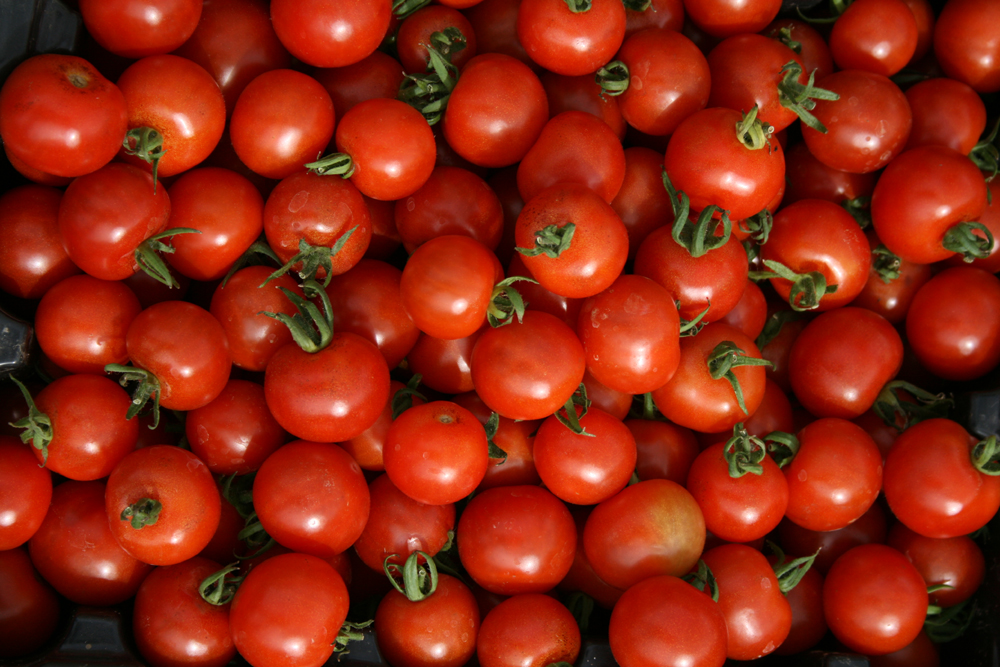
We can expect to find some tomatoes and a cauliflower among the contents of this week’s veg boxes.
These vegetables come from Richard Hore, our new supplier at Rest Harrow, Trebetherick (between Daymer Bay and Rock). They’re not grown to organic principles, but are freshly picked and have clocked up few food miles – barely five in fact.
The potatoes and onions are our own contribution to the harvest. They’ve been grown by our volunteers on Camel Community Supported Agriculture’s two-acre plot at St Kew Highway.
Our expert growers are providing the rest of the box contents. Salad bags – Jane Mellowship, cucumber and curly parsley – Jeremy Brown, celery – Mark Norman.
See this week’s Recipe No 8 – Braised celery
August 20, 2009
Camel Community Supported Agriculture is starting to source vegetables from outside suppliers. Up until now the contents of our weekly veg boxes have come from our own site at St Kew Highway and from our three expert growers.
Our business plan allows us to buy in up to 40% of box contents over the course of a year, but during the rest of Year Zero we may have to increase that proportion. Provided our bid for external funding is successful, this should not need to happen in the future.
This new move has led to some debate among members. It’s proved impossible to source sufficient organic vegetable supplies within a 30-mile radius. However we are in contact with some reliable small-scale local suppliers whose vegetables are not grown to organic principles.
Compromise
So we have a dilemma. Do we insist on organically-grown vegetables that could come from afar or do we buy local vegetables that may not be organic?
Either way, we have to compromise: either by clocking up extra food miles or temporarily abandoning our organic food-growing principles.
We’ve been sounding out the views of members at our recent volunteering sessions and over the ether. The response has been interesting.
With a couple of exceptions, members feel they would rather eat local food that is not strictly organic provided it comes from within our own immediate community in north Cornwall. They don’t like the idea of clocking up food miles by using suppliers who are some distance away – maybe as far as east Devon.
Local food
Ideally, the membership would like to source organic veg locally but realise this is not practicable in the short term. They say they’d rather keep our veg box scheme going over the winter months and use the opportunity to start building up important local networks of small vegetable growers.
Some responses from our members: –
“Very happy with that – a pragmatic response to a short term problem.”
“We would definitely support the option of buying in local non-organic veg over shipping it in from further afield or taking a box holiday.”
“Buy from local, especially small-scale local, rather than organic from further afield if necessary (fewer food miles).”
“We’d be happy with local produce even if not totally organic rather than shipping it in.”
Green manure
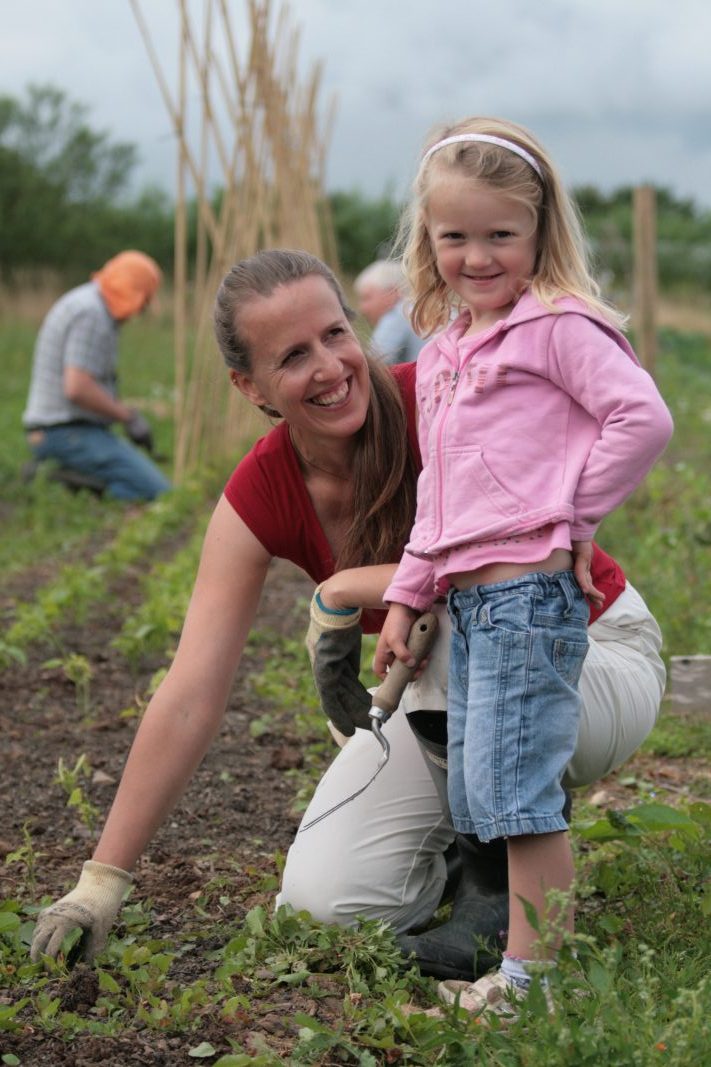
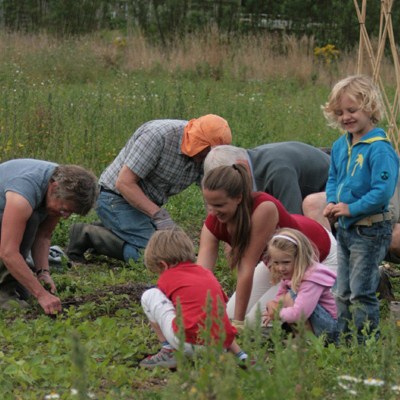
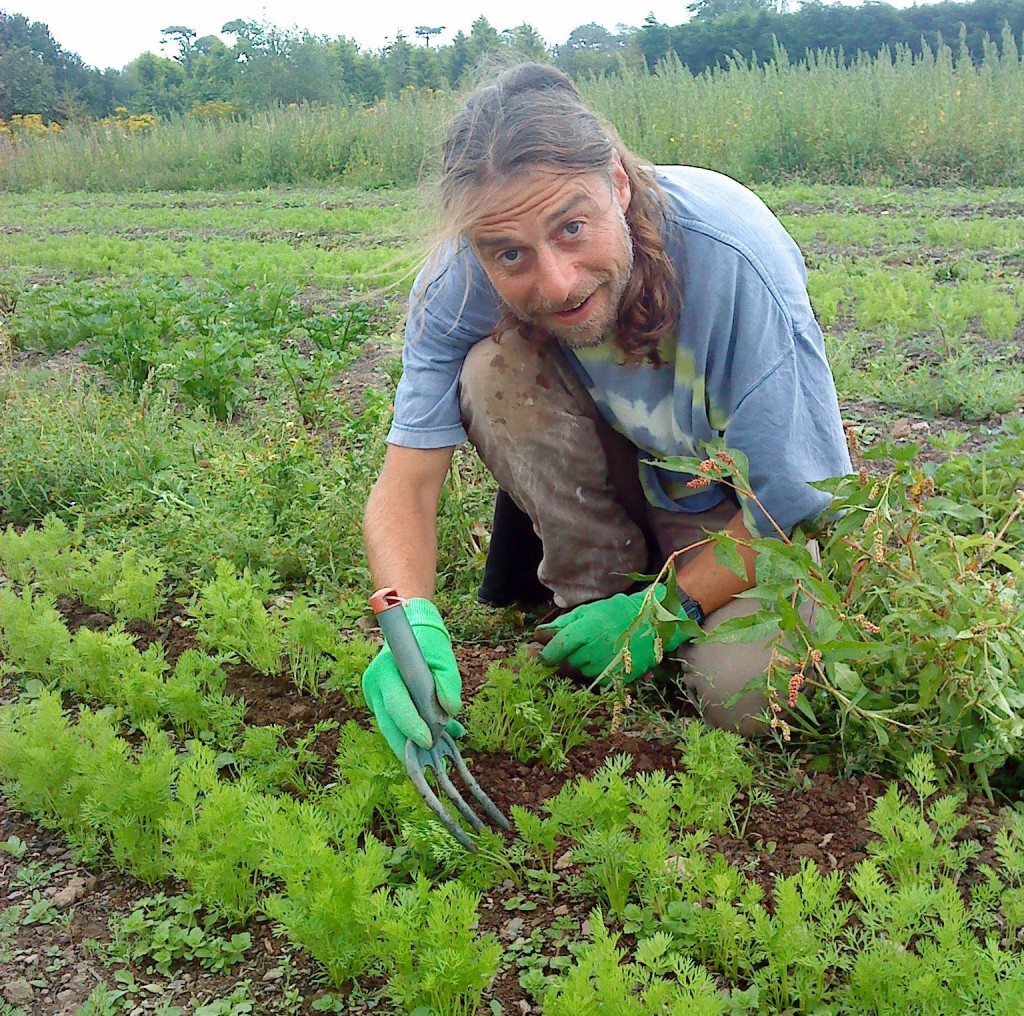
Our volunteer teams have been busy weeding row after row of carrots. We’ve also begun the laborious task of pulling up the plastic mulch from the disused strawberry beds in preparation for sowing a crop of green manure.
Thanks to Sunday’s volunteers – expert growers Jeremy and Mark N, helped by Carmen, Charlotte, Danny, Ian, Kitty, Mike H and Mike S, plus Finn aged five and three-year-old Keira.
A special mention to Steve, who singlehandedly weeded a whole 29-metre-long carrot bed on Friday. Trish masterminded the packing of the boxes along with pickers Charlotte, Mike H and Penny.
August 14, 2009
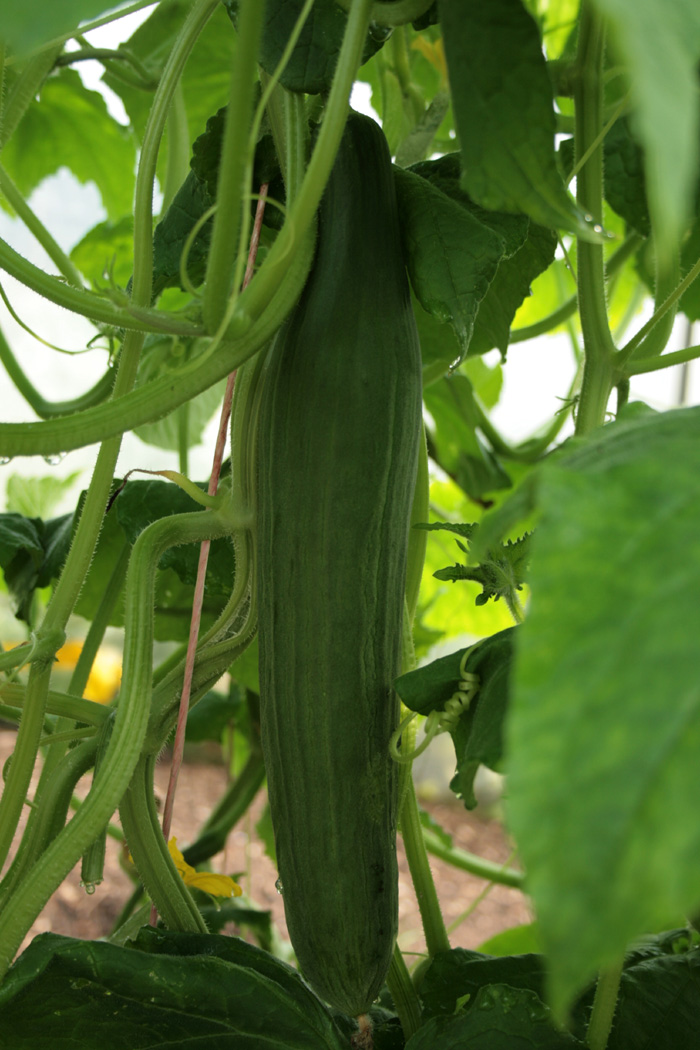
Serve this as a side dish with curries or simply as a dip. This recipe is from Sarah Raven’s Garden Cookbook. Without the turmeric and with a bit more garlic and a tablespoon of olive oil, you’ll have Greek tzatziki. And the Turkish cucumber and yoghurt salad cacik is pretty much identical too.
Draining time: 30 minutes
Preparation time: 5 minutes
Serves 4-6
Ingredients
½ cucumber
¼ teaspoon fine salt
200g mild natural yoghurt
small bunch of mint
1 garlic clove, finely chopped
small pinch of ground turmeric or paprika
Method
Grate the cucumber – you don’t need to skin – and put it in a sieve over a bowl. Sprinkle it with the fine salt and leave it to drain for half an hour. Pat the cucumber dry with kitchen paper. Mix with the yoghurt, mint, garlic and just enough water to give you the consistency you want, usually in the region of 100ml. Add a pinch of turmeric for extra flavour and pale yellow colouring or sprinkle paprika over the top.
Notes
I didn’t find it necessary to add water! There are many variations on this recipe: Delia Smith slices rather than grates the cucumber and adds a finely chopped spring onion, 2 pinches cayenne pepper and 1 pinch cumin seeds; Madhur Jaffrey doesn’t bother with draining the cucumber and uses 1 pinch roasted cumin seeds. But whichever way you make it, it’s a refreshing and cooling dish.
Click here to see all the recipes that Camel CSA members have recommended so far.
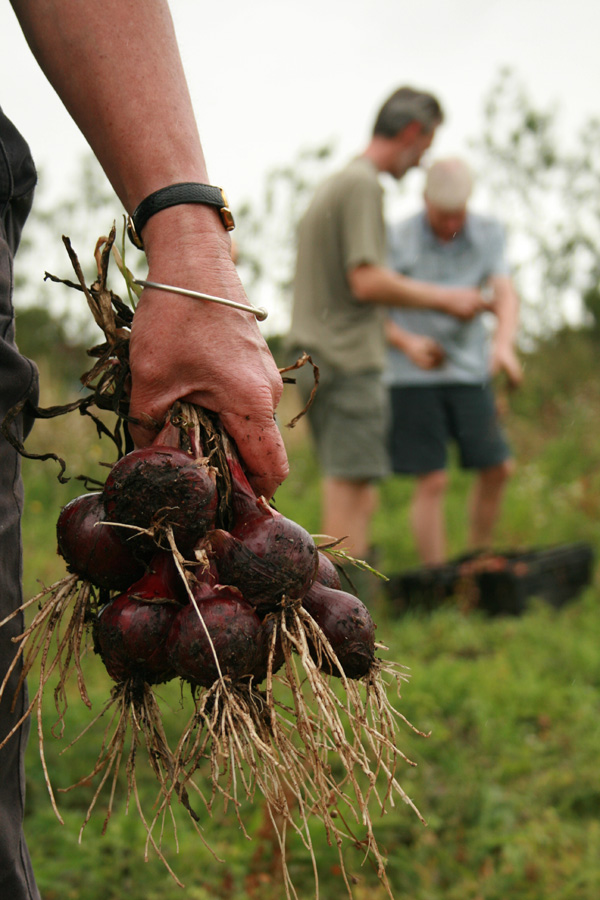 We are enjoying some more of our recently-harvested onions in Camel Community Supported Agriculture’s veg boxes this week.
The Swiss chard, beetroot and potatoes also come from our own plot at St Kew Highway.
Our expert growers have provided most of the rest of the vegetables. Jeremy Brown cultivated some of the cucumbers and the flat-leaved parsley. Jane Mellowship supplied the salad packs. Mark Norman grew the courgettes and the remaining cucumbers, which feature in our Recipe No 7 – Cucumber raita.
We have a new local supplier – Polmorla Market Garden, Wadebridge – which provided the freshly-picked runner beans. Unlike the rest of the box contents, these are not grown organically.
Oops!
The boxes also contain bunches of celeriac leaves, picked in ignorance as they were mistaken for mature flat-leaved parsley.
These could be used as a garnish on salads or soup. However they are rather coarse and have a distinctive, strong flavour.
It emerges that I may have caused irrevocable damage to our celeriac crop as a result of this inadvertent act of horticultural vandalism. This is one of the downsides of relying on enthusiastic amateurs like me.
S-o-o-o embarrassing!
August 11, 2009
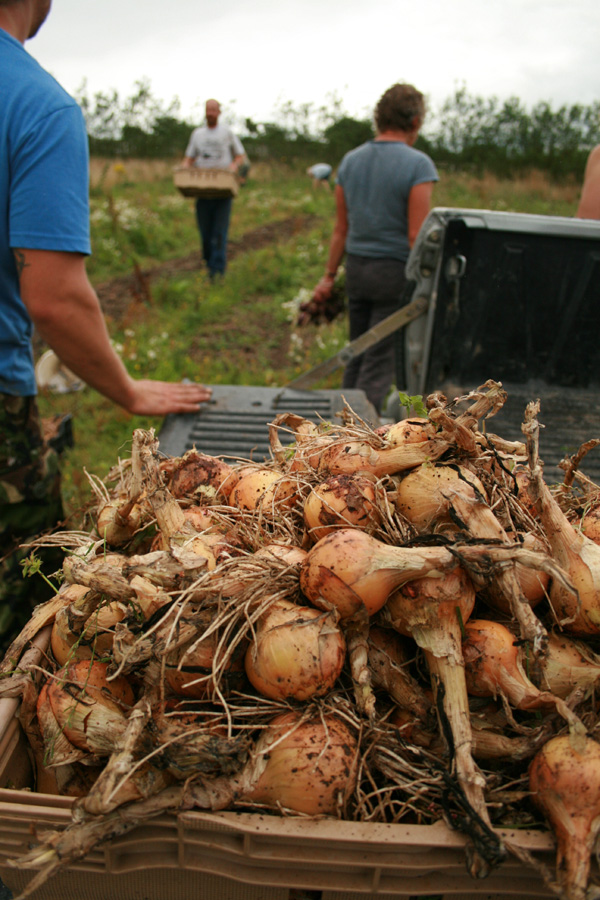
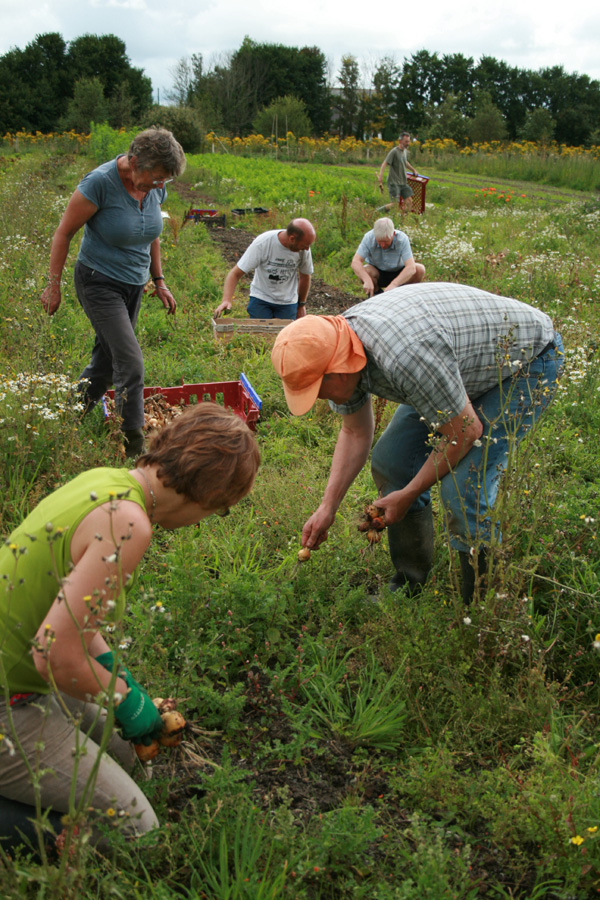
One vegetable that Camel Community Supported Agriculture members can rely on this season is the humble onion. There should be enough to fill the veg boxes until the New Year.
The growing team got on their hands and knees on Sunday and pulled up hundreds of red and white onions and a row of shallots before the heavens opened and the rain poured down (yet again).
Our onion harvest is now in dry storage in shed space kindly provided by Camel CSA volunteer Mark Malcolmson.
The expert growers have been taking an audit of what’s going to be available from our site at St Kew Highway over the next few weeks, apart from onions. We can expect more chard, beetroot, carrots, potatoes and parsley in the short term.
Pesky predators
In November we can look forward to cauliflower and two varieties of cabbage, followed by parsnips and kale. In December we should get some purple sprouting broccoli, with Jerusalem artichokes in January.
Unfortunately the runner beans, the French beans, the courgettes and our third crop of peas are all looking very sorry for themselves.
We’ve been overrun by voracious rabbits. It’s been a bad year for them. They’ve even been taking chunks out of the onions! The newest predators on the block are a family of partridges, which seem to love the peas.
Our financial wish-list includes predator-proof fencing and additional protective fleece, but we don’t have enough money at the moment to do anything more about this. Hence our bid for external funding.
Continuity of supply
In the meantime, we will continue to fill the gaps by buying in vegetables from our three expert growers. Mark Norman has plenty of courgettes, with leeks and swedes to come. He will also have celery and celeriac plus parsnips, potatoes and onions, if need be.
Jane Mellowship will continue to provide salad bags throughout the autumn and winter months. Jeremy Brown can supply salad leaves, tomatoes and cucumbers as well as peppers, chillies and pumpkins.
We are also busy looking locally for new partners who can supply us with potatoes, carrots and other mainstay items to help fill up our veg boxes during the autumn and winter.
Big effort
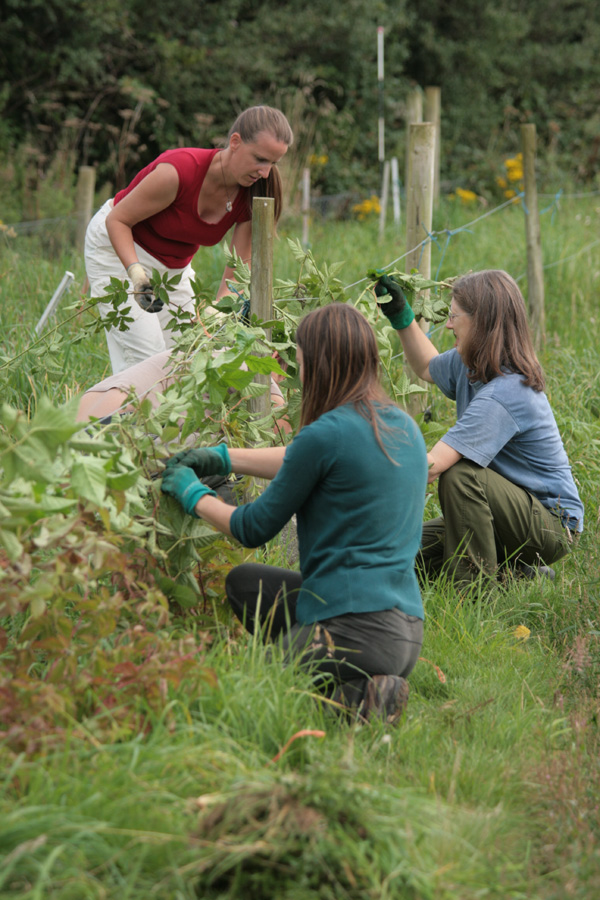
Volunteer growers, pickers and packers are making a fantastic effort at the moment on Friday and Sunday mornings.
Apart from harvesting the onions, the growers have made a concerted attack on the weeds, as well as pruning and tying up the boysenberries. All under the guidance of expert growers Jane, Jeremy and Mark N, helped variously over the two days by Charlotte, Danny, Fiona, Kitty, Mark M, Mike H, Mike S, Penny and Trish.
Friday’s picking and packing team comprised Callum (10), Leonie, Mark M, Mike H, Robert, Tom (11) and Trish, who packed the boxes. They harvested, sorted, counted out and bunched up enough vegetables to fill 23 boxes for grateful members. But they still need more rubber bands!
Many thanks to Jeremy G, who took the pictures.

August 10, 2009
Postal workers have been under fire for littering the ground with unwanted red rubber bands. But at Camel CSA we’re looking for as many as we can get.
Our picking and packing team urgently needs rubber bands for bunching up spring onions, chard, parsley and other such delicacies to go in our veg boxes.
So if you know of any postboxes where they get discarded, or have a small stash lying around at home or in the office, please drop them in for us at St Kew Harvest farm shop.
BBC News came up with 10 uses for a red rubber band but makes no mention of veg boxes. Pity.
August 7, 2009
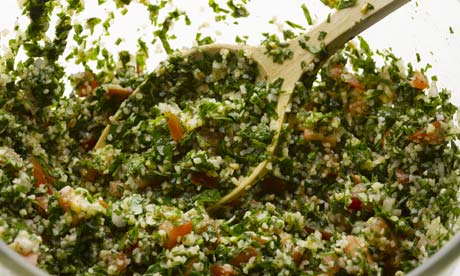
Bulgar wheat salad has an earthy taste and uses an abundance of parsley, which features in Camel Community Supported Agriculture’s veg boxes this week. This well-tried version of tabbouleh comes from Claudia Roden’s classic A Book of Middle Eastern Food.
Soaking time: 30 minutes
Preparation time: about 15 minutes
Serves 6
Ingredients
250g fine bulgar wheat
3 tablespoons finely chopped spring onions
Salt and black pepper
About one and a half teacups finely chopped flat-leaved parsley
3 tablespoons finely chopped fresh mint
4 tablespoons olive oil
4 tablespoons lemon juice
Cooked vine leaves, raw lettuce or tender cabbage leaves (to serve)
Method
Soak the bulgar wheat in water for about half an hour before preparing the salad. It will expand enormously. Drain and squeeze out as much moisture as possible with your hands. Spread out to dry further on a cloth.
Mix the bulgar wheat with the chopped onions, squeezing with your hands to crush the onions so that their juices penetrate the wheat. Season to taste with salt and pepper. Add the parsley, mint, olive oil and lemon juice, and mix well. Taste to see if more salt, pepper or lemon are required. The salad should be distinctly lemony.
Tabbouleh is traditionally served in individual plates lined with boiled vine leaves, or raw lettuce or cabbage leaves. People scoop the salad up with more leaves, served in a separate bowl beside it.
Notes
Claudia Roden adds: “As with most dishes, the preparation is highly individual. Quantities of ingredients vary with every family, but parsley is always used abundantly. This is a great Lebanese favourite.” More about Claudia Roden.
Compare her relaxed approach to Yotam Ottolenghi, chef/patron at Ottolenghi in London. He insists there’s a right way and a wrong way to make this refreshing summer salad. Click here to find out what he claims is the right way to do it.
Click here to see all the recipes that Camel CSA members have recommended so far.
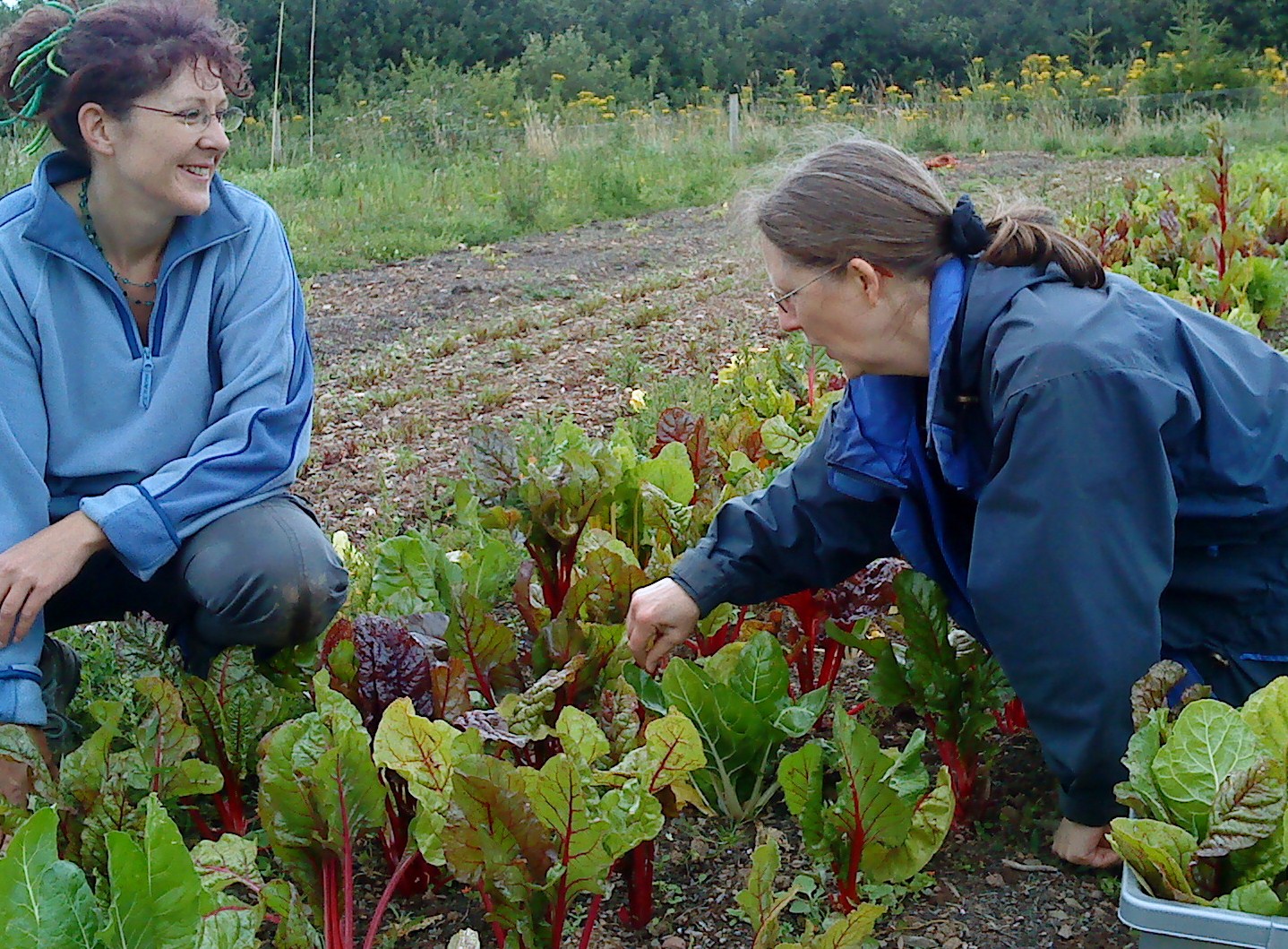 You’ve guessed it! We can expect more chard in the boxes this week plus a selection from potatoes, onions, spinach, white cabbage, courgettes, cucumber, salad leaves, parsley and spring onions.
The late start to Camel Community Supported Agriculture’s first planting season, the challenging growing conditions and the rising total of veg boxes are all taking their toll on the crops cultivated by our volunteers. We are gradually buying in more vegetables from our own expert growing team.
Mark Norman, one of our expert growers, reflects the observations of his vegetable growing colleagues:
“All vegetable growers have experienced three bad years in a row. The weather has been atrocious across Britain. All over the country, growers are complaining. For instance, the beans are not pollinating properly. The supermarkets are coping as they are importing from abroad.”
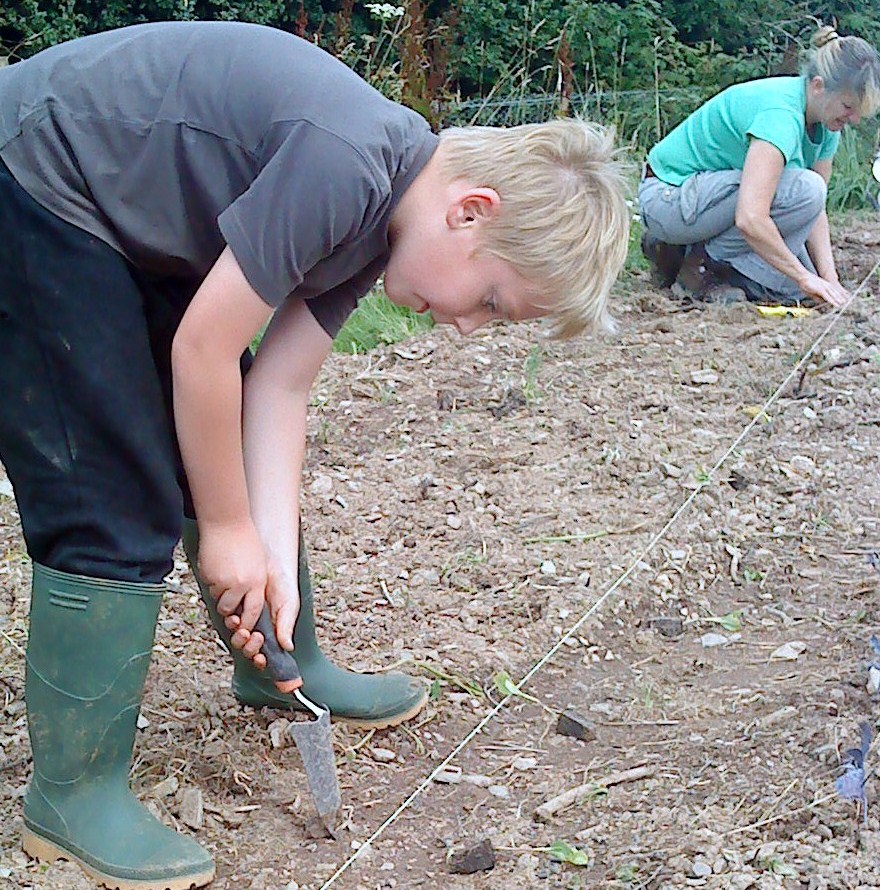 In spite of this, Camel CSA’s volunteers continue to turn out in all weathers. Thanks to last week’s picking team of Cath, Charlotte, Fiona, Mike H and Robert. Trish did the maths and masterminded the packing of the vegetable boxes.
The growing team took advantage of a dry morning on Sunday to plant out the remaining 10 rows of brassicas and cover them with fleece. We put in more than 750 plants, including Savoy cabbage (Vertus variety), cauliflower (Thalassa), Brussels sprouts (Igor and Darkmar) and red cabbage (Red Rum).
Thank you to expert growers Jane and Jeremy and to Carolyn, Cath, Charlotte, Danny, Kayleigh, Kitty, Mike H, Mike S. and six-year-old Haydn.
Now the planting’s over, it’s time to start lifting and storing our bumper crop of onions. And we need to make a concerted attack on the even larger crop of annual and perennial weeds…